High-Speed Rail Networks in Europe: Current Status and Future Expansions
Europe operates one of the most extensive high-speed rail networks in the world, spanning over 9,000 kilometers of dedicated track across more than a dozen countries. From the TGV lines threading through France to the AVE network dominating the Iberian Peninsula, these corridors have fundamentally reshaped how Europeans travel — cutting journey times that once required overnight trips down to a few hours. The network keeps growing, driven by EU climate targets, rising passenger demand, and a strategic push toward unified continental mobility.
Overview of Europe's Existing High-Speed Rail Infrastructure
Europe's high-speed rail infrastructure currently covers over 9,500 km of operational lines, with France, Spain, and Germany hosting the largest national networks. These lines form the backbone of modern intercity travel across the continent.
France's LGV network, originating in 1981 with the Paris-Lyon line, remains one of the oldest and most developed systems in the world. Spain's AVE network has grown remarkably since 1992 and now stretches further in total HSR route length than any other European country. Germany's ICE network, while operating on a mix of dedicated and upgraded track, connects major urban centers with reliable high-frequency service.
Italy, Belgium, the Netherlands, and the United Kingdom (pre-Brexit HS1) each contribute significant segments to the broader picture. The Trans-European Transport Network (TEN-T) framework has been instrumental in coordinating these national systems into a coherent European-level strategy, setting standards for interoperability and designating priority corridors for investment.
Passenger volumes across these lines have grown steadily. Eurostar carried over 11 million passengers annually before the pandemic, and services like Paris-Lyon routinely achieve seat occupancy rates above 70%, demonstrating the commercial viability of well-placed high-speed corridors.
Major High-Speed Rail Corridors and Their Economic Importance
The most economically significant HSR corridors in Europe connect major urban and commercial centers, generating measurable gains in labor market integration, tourism, and freight logistics. Three corridors illustrate the broader pattern clearly.
The Paris-Brussels-Amsterdam corridor, served by Thalys and Eurostar services, links three of Europe's most economically productive metropolitan areas. Journey time from Paris to Brussels runs under 1 hour 30 minutes, enabling same-day business travel that effectively expands the functional catchment area of all three cities. Studies of similar corridors suggest that each 10% reduction in travel time correlates with a 1-3% increase in cross-border economic activity along the route.
The Madrid-Barcelona-French border corridor transformed Spain's internal mobility after its 2008 completion. Barcelona-Madrid journey times fell from over 6 hours by conventional rail to around 2 hours 30 minutes. Air traffic on that route dropped by roughly 50% within five years — one of the clearest documented cases of modal shift from aviation to rail anywhere in the world.
The Milan-Rome-Naples axis is Italy's most commercially successful HSR route. Operated by both Trenitalia's Frecciarossa and the private operator Italo, it demonstrates that competitive open-access rail markets can drive frequency up and fares down simultaneously. This corridor connects regions representing well over half of Italy's GDP.
Future Expansion Projects and Timelines
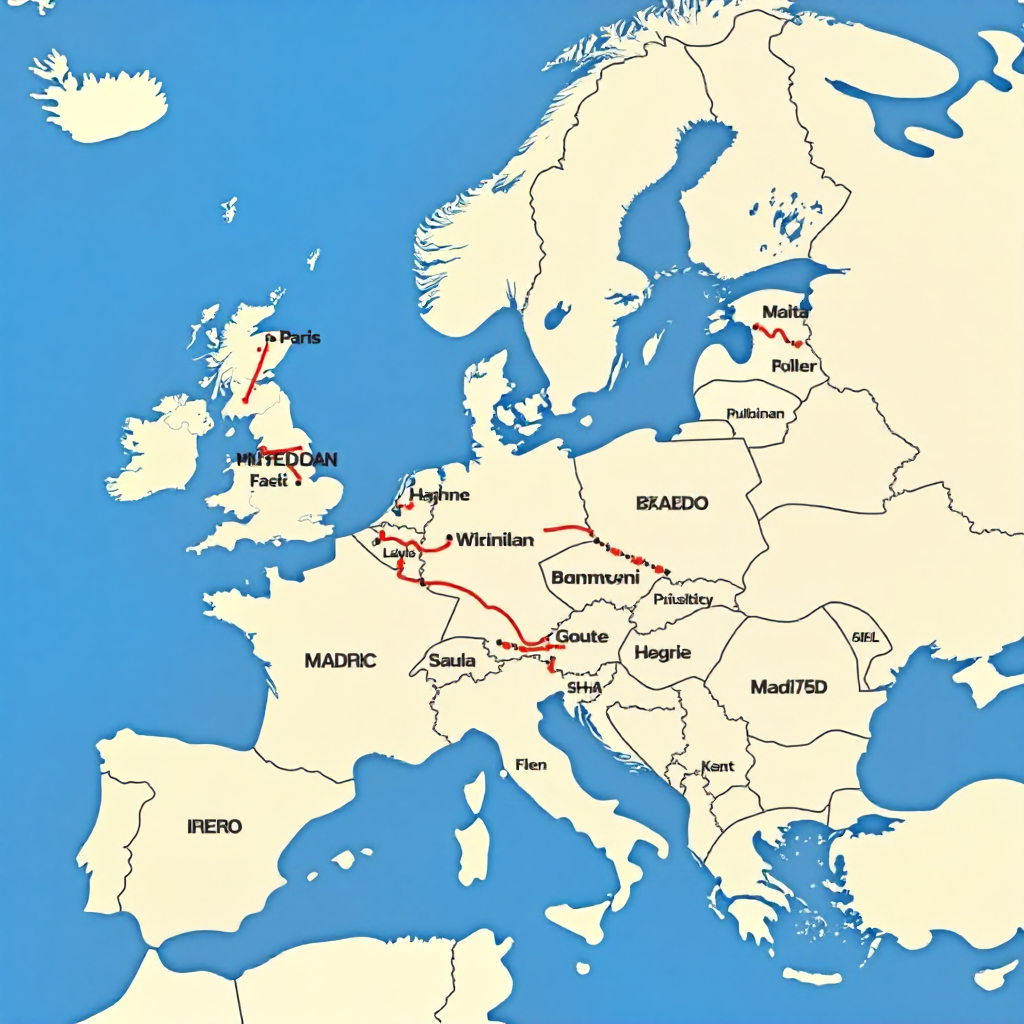
Europe's most consequential upcoming HSR projects will fill critical gaps in the existing network, particularly across Alpine crossings, the Baltic states, and Scandinavian routes. Several are already under active construction.
The Lyon-Turin base tunnel, the land portion of the broader Lyon-Turin HSR link between France and Italy, is the most complex active tunneling project in Europe. The main Fréjus tunnel — 57 km long — is expected to open around 2032. When complete, it will cut freight transit times across the Alps significantly and reduce lorry traffic on the Mont Blanc and Fréjus road tunnels.
Rail Baltica is arguably the most geopolitically significant rail project on the continent. This 870-km corridor will connect Tallinn, Riga, and Vilnius to Warsaw using standard European gauge track, ending the historic isolation of the Baltic states from the continental rail network. Full completion is targeted for around 2030, though some sections are already operational. The project addresses both economic integration and strategic connectivity concerns that have grown more pressing since 2022.
The Fehmarn Belt fixed link, a 18-km immersed tunnel between Denmark and Germany, will reduce Copenhagen-Hamburg rail travel time from around 4.5 hours to approximately 2.5 hours once the associated rail upgrades are complete. Tunnel construction is underway, with a target opening date around 2029.
Additional expansion is planned across Central and Eastern Europe, where HSR penetration remains limited. Poland, the Czech Republic, and Romania all have active HSR planning processes, supported by EU cohesion funding.
Funding and Policy Support for High-Speed Rail Development
EU infrastructure funding covers a significant share of high-speed rail project costs, with the Connecting Europe Facility (CEF) serving as the primary grant mechanism for cross-border and TEN-T corridor projects.
The CEF Transport budget for 2021-2027 totals approximately €25.8 billion, with a substantial portion allocated to rail. Grants typically cover 20-30% of eligible costs for commercially viable projects, rising to 85% for projects in cohesion fund regions. This structure means that Eastern European HSR expansions attract higher subsidy rates, accelerating deployment in countries where project finance would otherwise be prohibitive.
The TEN-T regulation, revised in 2023, tightened deadlines for completing the core network — the highest-priority tier — to 2030, with the comprehensive network required by 2050. This regulatory pressure has direct consequences: member states that miss milestones risk losing access to CEF co-financing for subsequent projects.
Alongside grants, the European Investment Bank provides long-term loans at favorable rates for qualifying rail infrastructure. Rail Baltica, for example, draws on a combination of CEF grants, EIB loans, and national contributions from Estonia, Latvia, and Lithuania.
Technological Advances Impacting High-Speed Rail
Modern signaling, electrification upgrades, and new rolling stock generations are collectively pushing European HSR toward higher speeds, greater capacity, and lower operating costs.
The European Rail Traffic Management System (ERTMS) is the most consequential technology initiative in European rail. By replacing dozens of incompatible national signaling systems with a single interoperable standard, ERTMS enables trains to cross borders without driver changes or system handoffs. Level 3 ERTMS, which eliminates physical track circuits and uses moving block principles, can increase line capacity by 20-40% on congested corridors without laying additional track.
Rolling stock continues to evolve. Alstom's Avelia Horizon, Siemens' Velaro, and Talgo's Avril platform all push operating speeds toward 350 km/h while reducing energy consumption per seat-kilometer compared to previous generations. Lightweight composite materials and regenerative braking systems contribute to efficiency gains in the range of 15-25% relative to 1990s-era high-speed trains.
Digital twin technology and predictive maintenance systems are extending asset lifecycles and reducing unplanned downtime. SNCF, for example, uses sensor data from Eurostar and TGV Duplex fleets to predict component failures up to two weeks in advance, reducing maintenance-related delays significantly.
Environmental Benefits and Challenges
High-speed rail produces dramatically lower carbon emissions per passenger-kilometer than aviation, making HSR expansion central to EU transport decarbonization strategy. The comparison is stark on most routes.
A Paris-London journey by Eurostar generates around 6 kg of CO₂ per passenger. The equivalent flight produces roughly 170 kg when accounting for full radiative forcing effects at altitude. On shorter routes like Paris-Brussels or Madrid-Barcelona, the rail advantage is even more pronounced since aircraft emit a disproportionate share of their emissions during takeoff and climb.
The environmental case gets more complicated when accounting for infrastructure construction. Building a new HSR line requires significant embodied carbon — tunneling in particular is energy-intensive, and the Lyon-Turin project has faced environmental scrutiny on these grounds. The full carbon payback period for a new HSR line, compared to the alternative of continued aviation, typically ranges from 5 to 25 years depending on electricity grid mix and passenger volumes. Lines powered by renewable-heavy grids, like those in France (predominantly nuclear) and Norway (predominantly hydro), reach payback much faster.
Noise pollution remains a genuine challenge, particularly for lines passing through dense urban areas or ecologically sensitive zones. Modern aerodynamic train design and track-side noise barriers have reduced impacts, but community opposition to new HSR routes often centers on noise and land use rather than carbon accounting.
Cross-Border Integration and the Future of European Rail Travel
Cross-border rail connectivity in Europe is improving, but fragmented ticketing systems, border-related delays, and incompatible infrastructure standards still create friction that domestic rail users never encounter.
The EU's push for integrated ticketing and through-ticketing across operators is gaining traction. The revised TEN-T regulation includes provisions requiring major stations to offer multimodal ticketing, and the European Commission has been pressing operators toward open data standards that enable third-party booking platforms to sell cross-border itineraries seamlessly.
Night trains are making a quiet comeback as part of this connectivity picture. Austrian Federal Railways (ÖBB) has aggressively expanded its Nightjet network, adding routes to Paris, Brussels, and Amsterdam since 2021. While night trains operate at conventional speeds, they extend the competitive range of rail against aviation for distances where a 12-14 hour overnight journey is more acceptable than a 6-8 hour daytime HSR ride.
Rail Baltica's completion will be the most transformative single connectivity event of the coming decade, bringing three EU capitals into direct standard-gauge connection with the continental network for the first time. Combined with planned upgrades on the Warsaw-Vilnius and Helsinki ferry connections, it creates a plausible future in which rail travel from Helsinki to Lisbon, while still a multi-day undertaking, becomes a genuinely competitive option to flying for travelers who value the journey as well as the destination.
Frequently Asked Questions
What are the fastest high-speed rail routes in Europe currently?
The fastest operational HSR services in Europe run at commercial speeds of up to 320 km/h. Spain's AVE services on the Madrid-Barcelona route and France's TGV on Paris-Lyon are among the quickest. China holds the global record for operational HSR speeds, but within Europe, the French LGV Sud-Est and Spanish AVE lines consistently rank at the top for maximum commercial operating speeds.
How does EU funding support high-speed rail projects?
The Connecting Europe Facility provides grants covering 20-85% of eligible costs depending on the project's location and cross-border significance. The European Investment Bank supplements this with long-term infrastructure loans. Projects on the TEN-T core network receive priority access to these instruments, which is why corridor designation carries direct financial consequence for member states.
Which future expansions will have the biggest impact on travel times?
Rail Baltica will have the largest network impact by creating entirely new high-speed connectivity for three countries. The Fehmarn Belt tunnel will cut Copenhagen-Hamburg time by roughly two hours. The Lyon-Turin link will open a fast Alpine crossing that currently has no high-speed equivalent. All three are transformative rather than incremental improvements.
How sustainable is high-speed rail compared to air travel?
On a per-passenger-kilometer basis, electrified high-speed rail produces roughly 80-95% fewer emissions than short-haul aviation on equivalent routes. The gap narrows somewhat when construction-phase embodied carbon is included, but on any route with strong passenger demand, HSR reaches carbon-positive status within a decade of opening. The sustainability case is strongest where the electricity grid is predominantly low-carbon.
What technological innovations are shaping Europe's HSR?
ERTMS interoperability, moving-block signaling, next-generation rolling stock with regenerative braking, and predictive maintenance systems are the four most consequential developments. ERTMS in particular addresses both safety and capacity simultaneously, making it the technology investment with the broadest network-wide impact. More information on ERTMS standards is available through the European Union Agency for Railways.