Sustainable Infrastructure: How Europe Is Reshaping Transport and Energy for the Green Transition
Europe is in the middle of the most ambitious infrastructure overhaul in its modern history. Driven by binding climate commitments and an unprecedented mobilisation of public and private capital, the continent is simultaneously rethinking how people and goods move, and how energy is generated, stored, and distributed. Transport and energy infrastructure are no longer separate planning silos — they are being designed as a single, interconnected system oriented around one goal: climate neutrality by 2050.
The Policy Framework Behind Europe's Green Infrastructure Push
The European Green Deal, launched in 2019, is the foundational policy framework driving Europe's green infrastructure agenda. It sets the continent's trajectory toward net-zero greenhouse gas emissions by 2050 and anchors a cascade of sector-specific legislation that translates ambition into binding obligation.
The "Fit for 55" package operationalises those commitments at a 2030 milestone — targeting at least a 55% reduction in net emissions relative to 1990 levels. For infrastructure developers, planners, and procurement professionals, this is not background context. It directly shapes what projects get funded, what specifications qualify for EU support, and which asset classes attract institutional capital.
Complementing the Green Deal, the revised Trans-European Transport Network (TEN-T) regulation sets hard deadlines for completing core corridors: high-speed rail connections, inland waterway upgrades, and multimodal freight hubs across all 27 member states. Similarly, the revised Renewable Energy Directive and the Energy Efficiency Directive create enforceable targets that feed directly into national infrastructure investment plans.
What makes this framework distinctive is its legal enforceability. Unlike previous voluntary commitments, the European Climate Law — adopted in 2021 — makes the 2050 neutrality target legally binding, with intermediate checkpoints that member states cannot simply defer.
Funding the Transition: Key Mechanisms and Investment Flows
Green infrastructure investment in Europe is financed through a layered system of EU instruments, national budgets, and private capital — often blended together to manage risk and scale delivery.
The Connecting Europe Facility (CEF) is the primary EU grant mechanism for cross-border transport and energy infrastructure. In its current 2021–2027 cycle, CEF allocates roughly €33.7 billion — with the transport strand prioritising TEN-T corridor completion and the energy strand targeting cross-border electricity interconnectors and smart grid projects.
InvestEU operates differently: rather than grants, it provides EU budget guarantees that de-risk private investment, mobilising capital from the European Investment Bank and national promotional banks. The cohesion funds — the European Regional Development Fund and the Cohesion Fund — channel additional resources toward member states where infrastructure gaps are largest, particularly in Central and Eastern Europe.
The EU taxonomy for sustainable finance underpins all of this. By defining what economic activities qualify as environmentally sustainable, the taxonomy determines which projects can be labelled as green bonds or green loans — directly affecting borrowing costs and investor appetite. For a rail electrification project or an offshore wind connection to attract the most competitive financing, alignment with taxonomy criteria is increasingly non-negotiable.
Private infrastructure funds have taken notice. Green infrastructure has become one of the fastest-growing asset categories among European pension funds and long-term institutional investors, attracted by stable regulatory frameworks and predictable revenue profiles.
Decarbonising Transport: Rail, EVs, and Multimodal Networks
The decarbonisation of European transport rests on three interlocking shifts: expanding electrified rail, deploying EV charging networks at scale, and integrating these into multimodal corridors that make low-carbon travel genuinely competitive with road and air.
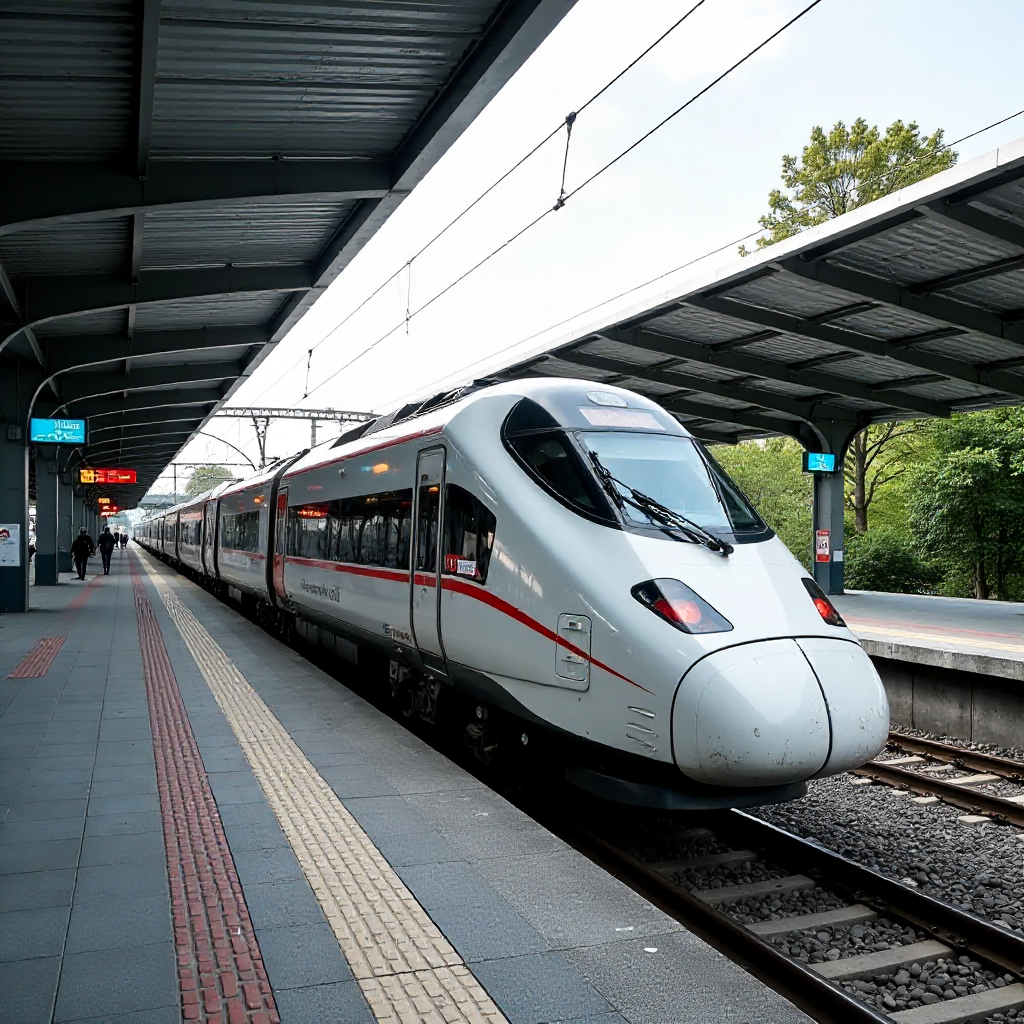
Rail electrification is the most capital-intensive piece of this puzzle. Several major member states still operate significant portions of their national networks on diesel traction — particularly on secondary and regional lines. TEN-T revisions now require electrification of the core network by 2030, pushing national rail managers and infrastructure operators to accelerate programmes that were previously decade-long planning exercises.
 Parallel to rail, the rollout of EV charging infrastructure is being shaped by the Alternative Fuels Infrastructure Regulation (AFIR), which mandates fast-charging stations at maximum 60km intervals along TEN-T core roads by 2025, with heavier-duty charging for trucks and coaches following on a slightly later timeline. This is not a voluntary target — it carries financial penalties for member states that miss deadlines.
The multimodal dimension is where the system logic becomes clearest. High-speed rail replacing short-haul flights on corridors like Paris–Brussels or Barcelona–Lyon, combined with interoperable ticketing and freight hubs that shift containers from road to rail — these are the components that make the network more than the sum of its parts. For project developers and procurement teams, this means planning individual assets within a corridor logic rather than as standalone interventions.
Energy Infrastructure: Grids, Renewables, and the Hydrogen Economy
Transforming Europe's energy supply requires building new generation capacity and fundamentally upgrading the grids that carry it — neither works without the other.
Offshore wind is the continent's largest-scale renewable expansion. The North Sea, Baltic, and increasingly the Mediterranean are seeing pipeline projects measured in gigawatts, with several member states committing to combined offshore targets that would make wind the largest single source of electricity generation within this decade. Solar capacity has grown faster than most projections anticipated, driven by falling module costs and streamlined permitting in some jurisdictions.
Smart grids are the enabling infrastructure that makes variable renewable generation workable at scale. Without upgraded transmission and distribution networks capable of two-way energy flows, demand response, and real-time balancing, adding gigawatts of wind and solar creates instability rather than resilience. EU network codes and the clean energy package are pushing grid operators toward digitalisation and cross-border coordination — though the pace varies considerably across member states.
Green hydrogen occupies a specific and still-evolving position in this picture. The EU Hydrogen Strategy targets 10 million tonnes of domestic renewable hydrogen production by 2030. Infrastructure for hydrogen — electrolysers, storage, and pipelines — is at an earlier stage of deployment than wind or solar, but several dedicated hydrogen valleys and backbone pipeline projects are moving through planning. Hydrogen's near-term role is most credible in hard-to-electrify sectors: heavy industry, shipping, and long-haul freight where battery-electric solutions face physical constraints.
Climate Resilience: Building Infrastructure That Lasts
Sustainable infrastructure means more than low-carbon. It also means infrastructure that can function reliably as the climate continues to change — and that dimension is increasingly integrated into EU project requirements.
The European Commission's climate-proofing guidance, applied to all projects receiving EU funding, requires developers to assess exposure to climate hazards — flooding, extreme heat, drought, sea-level rise — and demonstrate adaptation measures in project design. A rail line built to 2024 standards needs to operate under 2060 climate conditions.
This has practical consequences. Bridge and drainage specifications are being revised upward. Overhead line systems on electrified routes require heat tolerance margins that were previously unnecessary. Coastal energy infrastructure — ports, offshore substations, onshore grid connections — needs flood protection that accounts for projected sea-level scenarios rather than historical data.
Climate-resilient infrastructure and decarbonised infrastructure are not the same thing, but they are complementary. Building a new rail corridor that is electrified but poorly protected against flooding is an incomplete solution. The most sophisticated project frameworks now treat both dimensions as baseline requirements rather than add-ons.
Challenges: Permitting, Supply Chains, and Cross-Border Coordination
Europe's green infrastructure agenda faces three structural bottlenecks that collectively slow delivery more than any single policy gap: permitting timelines, supply chain constraints, and the difficulty of coordinating 27 sovereign member states.
Permitting is where ambition most consistently meets friction. Environmental impact assessments, grid connection queues, and land use approvals regularly extend project timelines by years — sometimes a decade for major infrastructure. The EU has responded with the Net-Zero Industry Act and emergency renewable energy permitting regulations that designate certain project categories as overriding public interest, but implementation at the national level remains uneven.
Supply chains present a different kind of risk. Offshore wind components, solar panels, battery systems for EV charging, and electrolysis equipment for hydrogen production all depend on materials and manufacturing capacity that is geographically concentrated outside Europe. The Critical Raw Materials Act addresses part of this, but building domestic processing and manufacturing capacity takes time that project pipelines cannot always absorb.
Cross-border coordination — required for interconnectors, shared rail corridors, and hydrogen backbone networks — adds layers of regulatory alignment, bilateral agreements, and financing negotiations that single-country projects avoid. The TEN-T framework provides a common reference, and the Connecting Europe Facility provides joint project incentives, but coordinating national rail managers, grid operators, and regulatory bodies across multiple jurisdictions remains one of the most demanding aspects of European infrastructure delivery.
What Comes Next: Priorities Through 2030 and Beyond
The period from now to 2030 will determine whether Europe's green infrastructure transition stays on track for 2050 climate neutrality — and the pipeline of priority projects is already defined.
On transport, completing the TEN-T core network remains the headline commitment. That means closing missing rail links, electrifying diesel-operated corridors, and delivering AFIR-compliant EV charging across all member states. The shift from planning to construction on several major cross-border rail projects — including connections in the Iberian Peninsula, the Baltic Rail corridor, and Alpine base tunnels — will be a visible indicator of delivery pace.
On energy, the priorities cluster around offshore wind connection infrastructure, smart grid upgrades, and the first phase of hydrogen backbone development. The European Hydrogen Backbone initiative — a proposed network of repurposed gas pipelines and new hydrogen-dedicated infrastructure — could connect major production and industrial consumption zones by the early 2030s if planning and financing decisions proceed on schedule.
For professionals tracking or working within this sector — whether in procurement, project finance, planning, or construction — the trajectory is clear even where individual project timelines remain fluid. The European Commission's Green Deal portal provides a regularly updated view of legislative progress and funding allocations across both sectors.
The 2030 milestones are close enough that delays are now measurable against binding targets, not just aspirational ones. That pressure — combined with the scale of capital mobilised and the policy frameworks in place — makes the green infrastructure transition one of the defining investment and delivery challenges in European infrastructure for the remainder of this decade.
Frequently Asked Questions
What is the EU taxonomy and how does it define sustainable infrastructure?
The EU taxonomy for sustainable finance is a classification system that defines which economic activities qualify as environmentally sustainable under EU law. For infrastructure, it sets technical screening criteria — covering climate change mitigation, adaptation, and other environmental objectives — that a project must meet to be labelled as green for financing purposes. Alignment with the taxonomy affects access to green bonds, institutional investment mandates, and certain EU grant instruments.
Which European countries are furthest ahead in green transport investment?
The Nordic countries, France, the Netherlands, and Germany have generally led in rail electrification rates and EV charging density. However, several Central and Eastern European member states are accelerating rapidly, supported by cohesion funds and TEN-T corridor requirements that mandate completion timelines regardless of starting position.
How does the Connecting Europe Facility allocate funding to projects?
The Connecting Europe Facility allocates funding through competitive calls for proposals. Projects are evaluated against criteria including cross-border relevance, contribution to TEN-T network completion, climate and environmental performance, and maturity of project preparation. A portion of the transport strand is ring-fenced for cohesion countries to ensure geographic balance.
What role does green hydrogen play in Europe's future energy infrastructure?
Green hydrogen — produced from renewable electricity via electrolysis — is positioned as a solution for sectors where direct electrification is technically or economically difficult: heavy industry, maritime shipping, and long-haul road freight. Near-term infrastructure investment is focused on electrolyser deployment, storage facilities, and repurposing existing gas pipelines for hydrogen transport. Large-scale hydrogen trade between Northern Africa, the Middle East, and Europe via dedicated import terminals is also part of the medium-term supply picture.
How are private investors participating in Europe's green infrastructure transition?
Private investors participate primarily through project finance structures for renewable energy assets, infrastructure funds targeting operational or late-construction-stage assets, and green bond markets. The EU taxonomy and InvestEU guarantees have lowered the risk threshold for institutional capital. Pension funds, sovereign wealth funds, and infrastructure-focused private equity have all increased allocations to European green infrastructure, attracted by long-duration, regulated revenue profiles and policy-backed demand visibility.