Digital Infrastructure in the EU: How 5G and Fiber Optics Are Being Deployed
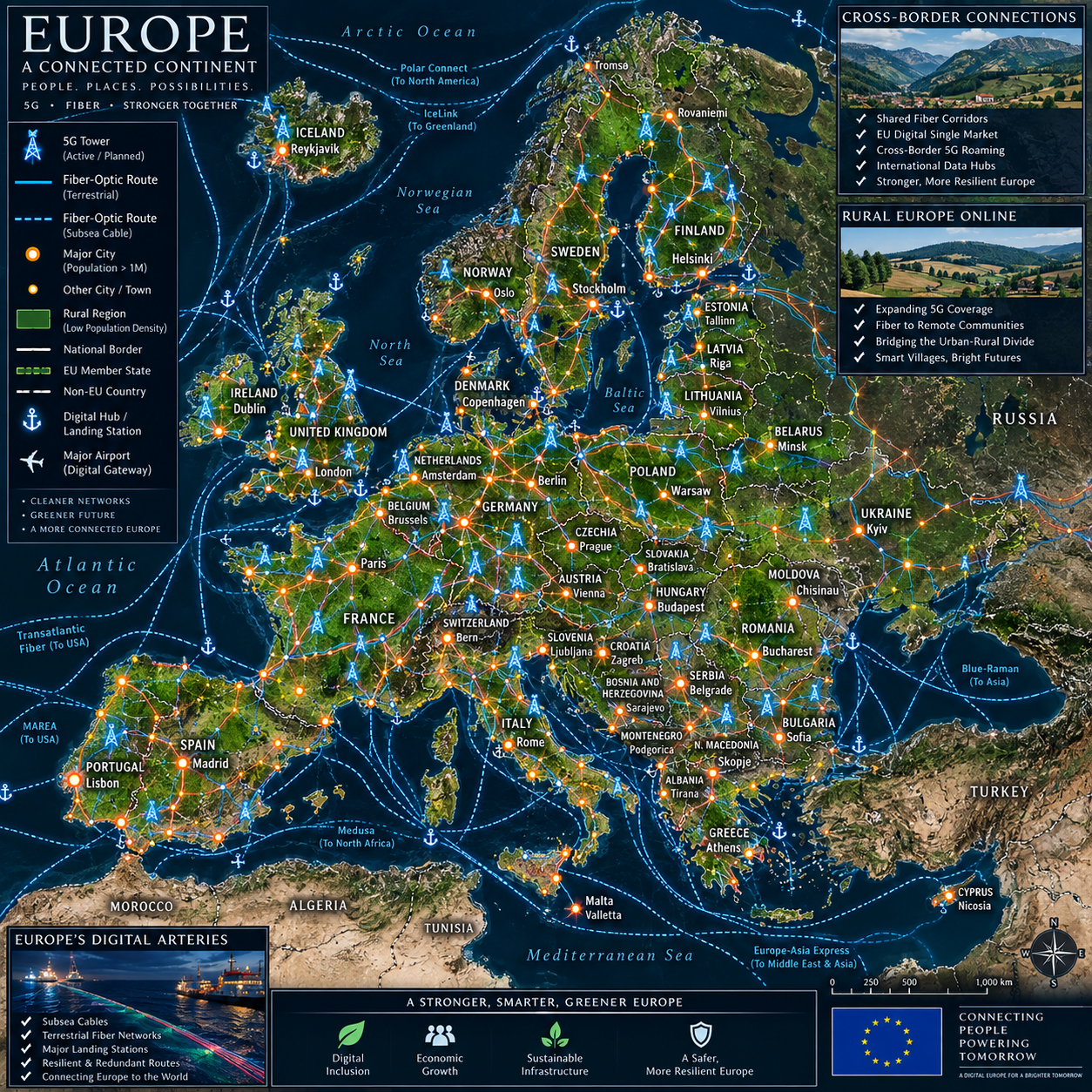
Europe’s digital infrastructure is being rebuilt around two connected technologies: 5G networks for mobile, low-latency services and fiber-optic broadband for high-capacity fixed connectivity. Together, they support the European Union’s ambitions for gigabit connectivity, competitive industries, resilient public services, and more balanced regional development.
Deployment is progressing, but not evenly. Dense metropolitan areas and major industrial corridors generally attract investment first, while rural, remote, border, and economically disadvantaged regions face higher construction costs and weaker commercial returns. The result is a large infrastructure programme shaped as much by planning, finance, and public policy as by telecommunications technology.
Why Digital Infrastructure Matters to the EU
European Union digital infrastructure provides the physical foundation for economic growth, public services, resilience, and regional cohesion. Reliable high-speed connectivity allows businesses, governments, schools, hospitals, and households to exchange data and use digital services at scale.
For companies, dependable networks support cloud computing, online trade, cybersecurity operations, advanced manufacturing, and distributed work. Industrial sites increasingly need secure connections between sensors, machines, logistics systems, and control platforms. Without sufficient capacity and reliability, investment in artificial intelligence, automation, and data-intensive services becomes harder to justify.
Public services depend on the same foundation. Telemedicine, digital identity, online administration, emergency communications, remote education, and intelligent transport systems all require networks that perform consistently during everyday use and periods of disruption. Fiber routes and mobile networks also improve resilience when they are designed with route diversity, backup power, and cross-border redundancy.
The regional dimension is equally important. A village with gigabit access can host remote workers, small technology firms, and digitally enabled public services. Yet connectivity alone cannot reverse regional decline. Skills, affordable devices, digital literacy, housing, and local economic capacity must develop alongside the network.
The EU’s Digital Decade policy programme frames connectivity as part of a wider transformation involving digital skills, business adoption, public services, and secure infrastructure. This broader approach matters because a fiber cable or 5G radio site creates potential; local institutions and businesses determine how much of that potential becomes economic value.
5G and Fiber Optics: Complementary Technologies
5G and fiber optics serve different but interdependent roles: fiber carries enormous volumes of data over fixed routes, while 5G connects mobile devices, machines, vehicles, and sensors with low latency and flexible coverage.
Fiber-to-the-premises networks extend optical cable directly to homes, offices, public buildings, and industrial sites. They offer high capacity, stable performance, and strong long-term upgrade potential. Fiber also forms the backbone and middle-mile infrastructure linking data centres, internet exchanges, mobile sites, municipalities, and national networks.
5G uses radio access networks, including antennas and base stations, to provide mobile connectivity. It can support dense urban usage, connected transport, industrial automation, remote monitoring, and temporary or rapidly changing sites. Its value is greatest where mobility, responsiveness, or large numbers of connected devices matter.
These technologies should not be treated as competing infrastructure. Most 5G traffic eventually travels through fiber backhaul from the radio site into the wider network. A 5G antenna without adequate backhaul may offer impressive radio performance but still deliver limited service during busy periods.
A practical infrastructure model
- Access network: the final connection to a home, business, building, or mobile user.
- Middle mile: the regional links connecting local access networks to larger aggregation points.
- Backbone: high-capacity national and international routes linking data centres, exchanges, and major population centres.
- Mobile layer: 5G radio sites, antennas, spectrum, and core-network systems.
Investment decisions should therefore consider the complete chain. Choosing 5G for mobility means accepting dependence on dense site planning and fiber or equivalent backhaul. Choosing fiber for fixed capacity means accepting civil-works costs and longer construction schedules.
Where 5G Deployment Is Advancing Across Europe
5G deployment is advancing fastest where population density, industrial demand, transport activity, and existing network assets make investment commercially attractive. Progress varies considerably between member states, municipalities, and individual regions.
Large cities are natural early deployment zones because operators can serve many users from a relatively concentrated set of sites. Urban 5G supports higher-capacity mobile broadband, connected public spaces, digital administration, and experimental smart-city applications. However, city coverage on a map does not always mean consistent indoor performance or capacity at peak times.
Industrial areas provide a different use case. Factories, ports, warehouses, energy facilities, and research campuses can use private or dedicated 5G networks for machine monitoring, robotics, asset tracking, and worker safety. These projects often require careful coordination among network operators, equipment suppliers, industrial companies, and regulators.
Transport corridors are another priority. Connected roads, railways, ports, and airports need reliable communications for traffic management, operational monitoring, passenger information, and future automated systems. Cross-border routes create additional complexity because coverage, spectrum coordination, procurement rules, and technical standards must work across national boundaries.
Rural deployment usually advances more slowly. Lower population density reduces revenue per site, while hills, forests, islands, and long distances increase construction and maintenance costs. Public support can make rural 5G viable, particularly where it serves farms, local industry, schools, health facilities, or emergency services.
Expanding Fiber-Optic Networks
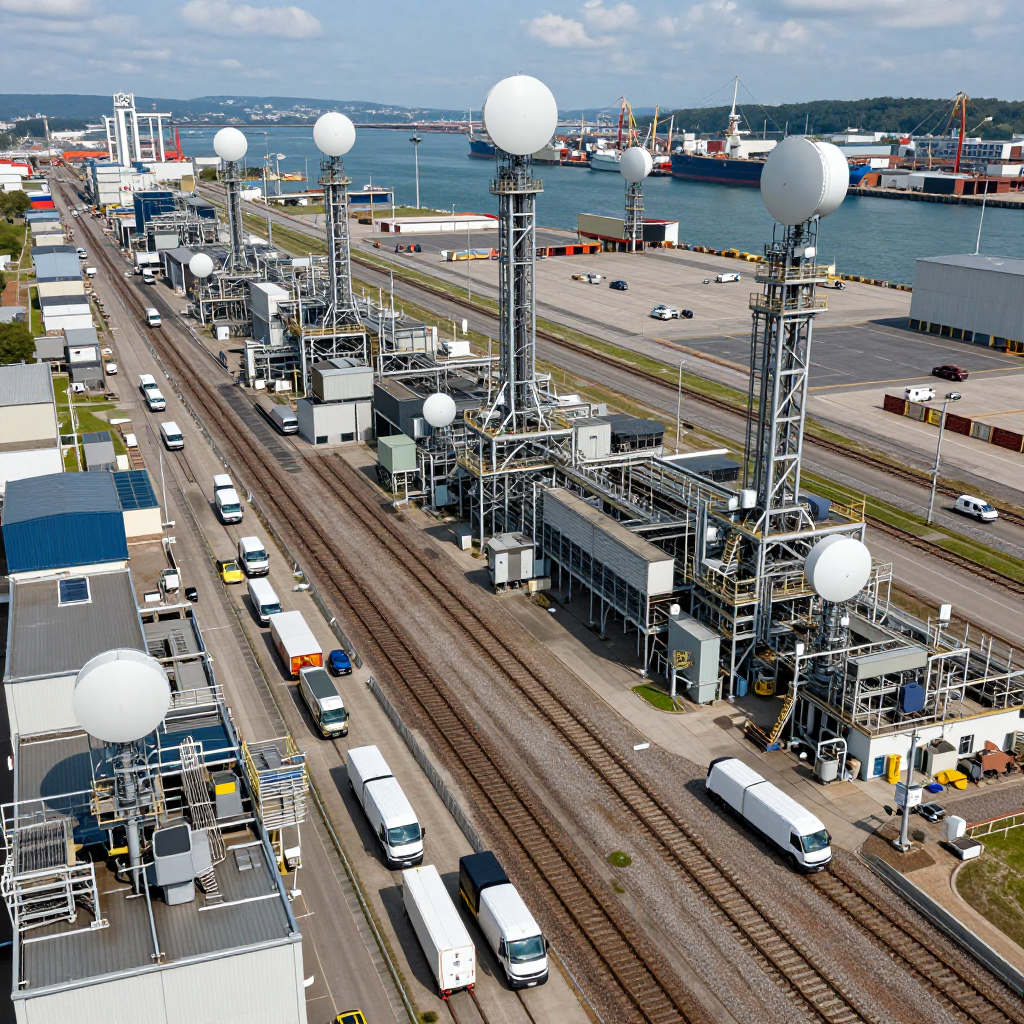
Fiber-optic expansion is the central route to gigabit connectivity because it provides high capacity to homes, businesses, public institutions, mobile sites, and regional data hubs.
Fiber-to-the-premises, often described as fiber-to-the-home or fiber-to-the-building depending on the final connection, replaces older copper segments with optical cable. This reduces dependence on aging infrastructure and creates a platform that can support future increases in data demand.
Urban fiber projects can use existing ducts, utility corridors, apartment risers, and street infrastructure. Even there, the final connection to each building can be difficult. Permits, landlord access, road reinstatement, heritage rules, and coordination with electricity or water works all influence delivery time.
Rural and underserved regions present a tougher economic case. Operators may need to build long routes for relatively few premises, cross difficult terrain, or connect islands and remote communities. Public authorities can improve viability through grants, wholesale-access requirements, shared ducts, infrastructure mapping, and open-access networks that allow several service providers to use the same physical assets.
A useful project test is the route-and-demand check: first identify the shortest resilient route, then map schools, clinics, businesses, housing clusters, farms, public offices, and mobile sites along it. A route that serves several types of demand often produces more public value than a project designed around household connections alone.
Fiber also supports digital sovereignty and resilience. Diverse international routes, regional data centres, and protected backbone paths reduce dependence on a single corridor. They do not eliminate outages, but they make recovery and traffic rerouting more practical.
EU Policies, Funding, and Infrastructure Projects
EU connectivity projects combine policy targets, national broadband plans, public funding, and private investment. The European Commission sets strategic direction, while member states and regional authorities usually determine project design, permits, procurement, and delivery.
The Digital Decade policy programme establishes a framework for widespread gigabit connectivity and advanced mobile coverage. National plans translate those ambitions into maps, deadlines, subsidy schemes, spectrum decisions, and rules for infrastructure sharing.
Several EU-level instruments can support digital infrastructure, depending on project eligibility and national implementation. These include the Connecting Europe Facility, the European Regional Development Fund, the Cohesion Fund, the Recovery and Resilience Facility, and InvestEU-related financing mechanisms. Projects may also combine European money with national budgets, municipal contributions, development-bank loans, and operator capital.
Public-private partnerships are particularly useful where commercial deployment is incomplete but the public interest is clear. A public authority may finance passive infrastructure such as ducts, towers, or fiber routes, while private operators manage active equipment and retail services. Other models include concession arrangements, wholesale-only networks, co-investment, and targeted vouchers.
Project quality depends on more than the size of the grant. Strong programmes define measurable coverage, service quality, affordability, maintenance responsibilities, open-access terms, and construction milestones. They also account for future expansion so that today’s subsidised network does not become tomorrow’s bottleneck.
Key Challenges to Faster Deployment
Permitting, high construction costs, geography, coordination, skills shortages, and uneven investment are the main barriers to faster 5G and fiber deployment across the EU.
Permitting and civil works
Road openings, tower approvals, building access, environmental assessments, and heritage restrictions can delay projects even when financing is available. A single route may cross several municipalities, each with different procedures. Common application portals, standard time limits, and coordinated street works can reduce avoidable delays.
Economics and geography
Fiber trenches and mobile sites are expensive in mountains, forests, islands, and sparsely populated areas. Choosing universal coverage everywhere may require substantial subsidy. Authorities must balance speed, resilience, affordability, and long-term operating costs rather than selecting the lowest initial construction price.
Spectrum and network coordination
5G depends on suitable spectrum, interference management, site access, and compatible equipment. Cross-border coordination is especially important near national frontiers, where inconsistent planning can leave transport corridors or rural communities with gaps.
Skills and uneven investment
Europe needs engineers, planners, fibre technicians, construction crews, cybersecurity specialists, and project managers. Shortages can raise prices and extend schedules. Investment is also uneven: commercially attractive regions may receive several competing upgrades while remote communities wait for a publicly supported project.
- Common mistake: measuring success only by households passed. Correction: track active connections, affordability, reliability, public-site access, and business adoption.
- Common mistake: building 5G radio sites without securing adequate backhaul. Correction: plan fiber or other high-capacity transport at the same time.
- Common mistake: treating rural coverage as a single technical problem. Correction: combine fiber, fixed wireless access, mobile coverage, satellite where appropriate, and shared infrastructure according to local geography.
What Better Connectivity Means for European Regions
Better connectivity helps European regions modernise businesses, improve public services, strengthen transport systems, and reduce the digital divide. The benefits appear when infrastructure is linked to local programmes and practical demand.
Smart cities can use fiber and 5G to connect traffic signals, public transport, environmental sensors, lighting systems, and emergency services. Industrial regions can coordinate factories, ports, energy networks, and logistics platforms with lower latency and better visibility. These applications require strong cybersecurity and governance; collecting more data does not automatically produce better decisions.
Healthcare providers can use reliable connections for remote consultations, image transfer, monitoring, and coordination between local clinics and specialist hospitals. Schools and training centres can support cloud learning and collaboration. Public administrations can offer digital services without forcing residents to travel long distances, although assisted in-person channels remain necessary for people with limited digital skills.
For rural economies, the most valuable result may be flexibility. A small manufacturer can sell beyond its local market, a farm can adopt connected equipment, and a professional can work remotely without relocating. These outcomes depend on affordable service, suitable skills, and local business support rather than network availability alone.
The EU’s infrastructure challenge is therefore best understood as a connected system. Fiber provides the high-capacity foundation, 5G adds mobility and responsiveness, public policy directs investment toward strategic gaps, and regional institutions convert access into social and economic value. Progress will remain uneven, but coordinated deployment can make the digital divide narrower and Europe’s infrastructure more resilient.
Frequently Asked Questions
What is the difference between 5G and fiber-optic connectivity?
Fiber-optic connectivity uses fixed optical cables to deliver very high capacity to homes, businesses, public facilities, and network hubs. 5G uses radio signals to connect mobile devices, vehicles, machines, and sensors. Fiber generally provides the fixed foundation, while 5G provides flexible wireless access.
Why is fiber important for 5G deployment?
Fiber supplies high-capacity backhaul between 5G radio sites and the wider network. Without sufficient backhaul, an antenna may have strong local radio coverage but limited overall performance when demand increases.
Which European areas face the greatest connectivity challenges?
Remote rural areas, islands, mountainous territories, sparsely populated regions, border zones, and economically disadvantaged communities often face the greatest challenges because construction costs are high and commercial demand is dispersed.
How do EU programmes support digital infrastructure projects?
EU programmes can provide grants, loans, guarantees, policy coordination, and technical frameworks. National and regional authorities then combine these resources with domestic funding and private investment to support fiber, 5G, backbone, and public-service connectivity projects.
What are the main obstacles to expanding 5G and fiber networks?
The main obstacles include slow permitting, expensive civil works, difficult geography, limited skilled labour, spectrum coordination, fragmented procurement, and uneven investment incentives. Effective projects address these issues during planning rather than after construction begins.